Typography Guide

Aligning Text Blocks in Multipage Documents

Practical methods for locking columns to baseline grids, eliminating vertical drift across facing pages, and sustaining uninterrupted visual rhythm in extensive publications.

Document Overview

Baseline Synchronization Across Facing Spreads

Multipage documents collapse visually when adjacent columns float without reference to a unified vertical baseline grid. By establishing master rhythm intervals, designers ensure headlines, lead paragraphs, and tabular breakouts sit on strict shared lines across spreads.

Editorial Specifications

Layout Discipline
CorelDRAW multipage layout
Systemic Type
Systematic typography
Format Purpose
Brochure layout
Grid Architecture
12-column compound with 14pt vertical baseline
Baseline Measure
4.938 mm (14pt leading on 10pt primary text)
Page Family Scope
Spreads 02 through 48
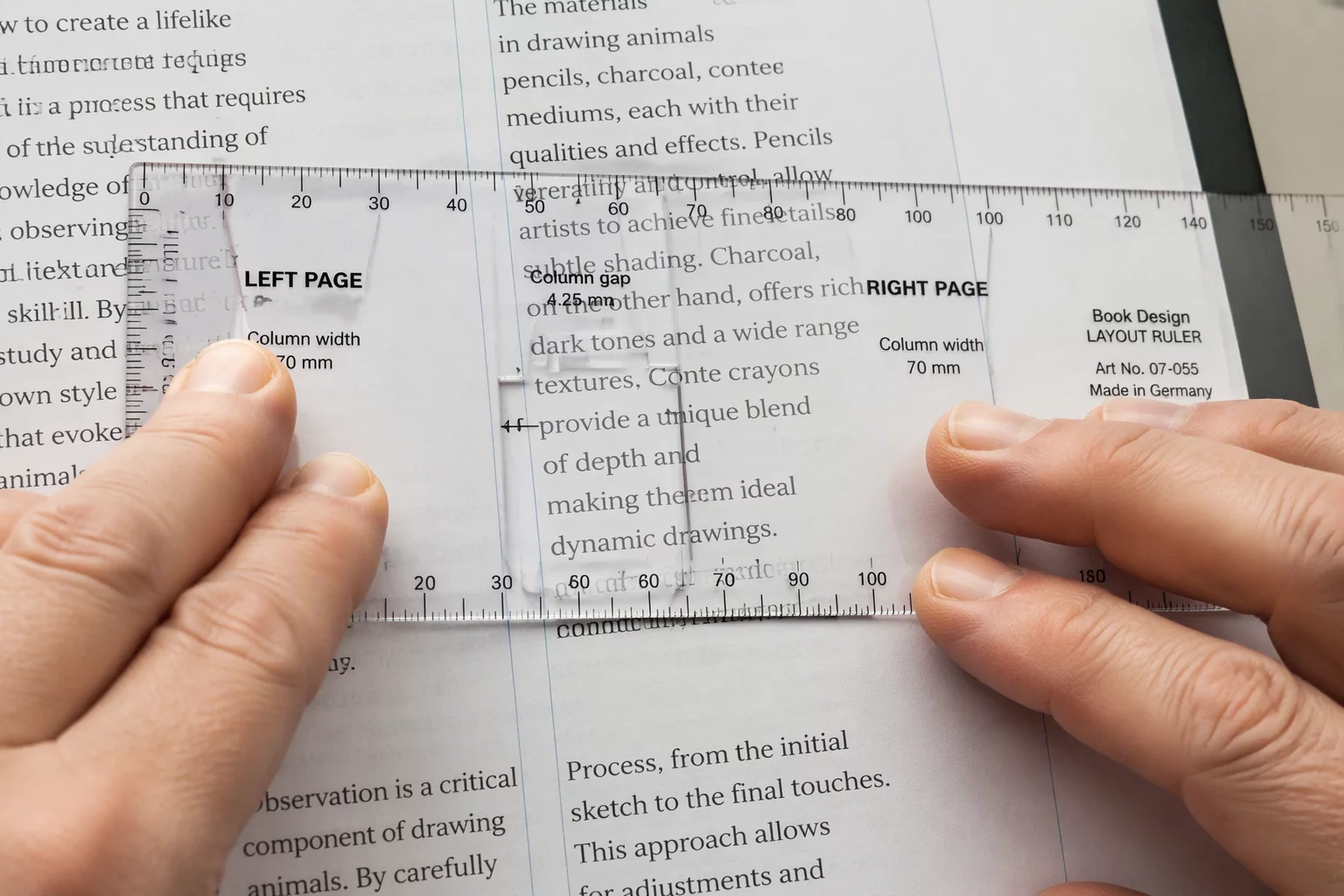
Designer using a transparent graphic ruler to inspect text alignment and baseline margins on a printed editorial proof
01

Establishing the Master Vertical Increment

In any extensive brochure layout, page cohesion relies on an invisible vertical pulse. When text frames float arbitrarily, facing pages display jagged horizontal breaks that tire reader comprehension. Setting up an unyielding baseline increment inside your CorelDRAW multipage layout anchors primary text blocks, ensuring paragraph baselines match across gutters regardless of column width.

Designers calculate this increment directly from the primary body copy size and its line spacing. When body type sits at 10 points with 14 points of leading, all subsequent spacing tokens—subheadings, blockquotes, and figure captions—must adopt multiples or half-increments of that 14-point interval.

  • Lock primary text frames to top document margins rather than optical positioning.
  • Configure paragraph spacing to add leading in whole-line increments instead of arbitrary point padding.
  • Align caption boxes and side notes to snap baselines directly with adjacent editorial columns.
02

Managing Heading Insets and Leading Drift

Subheads inevitably introduce disruption into disciplined column flow. Because display sizes demand looser or tighter line spacing, inserting an h2 or h3 element frequently shifts the subsequent body paragraph off the baseline grid. Effective typography overcomes this challenge by designing custom leading and margin offsets that return the subsequent paragraph exactly onto the next active grid line.

True structural elegance emerges when text frames on facing pages meet across the gutter with microscopic precision, turning individual columns into a singular reading architecture.
— James Sterling, Editorial Layout Director

When working across multi-column spreads, calculate the combined space above and below subheadings. If a section heading requires 18pt type with 22pt leading, balance the preceding space before and trailing space after so their sum equals an exact multiple of the baseline unit. This arithmetic maintains unbroken horizontal reading lines from left page to right page.

03

Controlling Bottom Column Alignments Across Spreads

Facing pages with uneven column footers give multi-chapter brochures an unfinished appearance. When one column terminates two lines shorter than its companion, negative space appears accidentally hollow rather than intentional. Correct alignment requires fine-tuning tracking, hyphenation limits, and paragraph breaking parameters across the entire document spread.

Rather than relying on automated frame justification—which distorts vertical leading and introduces distracting white streaks—apply disciplined editorial interventions to balance bottom lines:

  1. Adjust tracking across lengthy paragraphs within a conservative range of minus one to plus one percent.
  2. Recalibrate hyphenation zones to eliminate premature line wraps without creating loose line measures.
  3. Balance running copy between columns using manual column breaks locked strictly to baseline intervals.
Layout Consultation

Audit Your Multipage Publication Architecture

Bring your draft publications to our PageFamily workshop desk for an in-depth baseline grid and column alignment evaluation before going to print.